Free Solar Panel Installer Training
Get free solar panel installer training online, learn the skills employers want, and start a clean-energy career without paying upfront.
Advertisement
Have you ever looked at a rooftop full of solar panels and wondered who actually put them there, and how much they earn?
That job has a name: solar photovoltaic (PV) installer. And you can start learning it right now, for free, from home.
This guide shows you how to find free solar panel installer training online, what the coursework covers, and how to turn it into a real, paid trade.
The best part is that you do not need a college degree or thousands of dollars to begin. You need internet access and a willingness to learn.
Solar is one of the fastest-growing trades in the United States, and demand for installers keeps climbing year after year.
Here is what we will cover: why the trade is worth it, what free training actually teaches you, how certification works, the growing battery-storage career path, and exactly where to take free courses today.
Why Solar Installer Is a Smart Trade to Learn
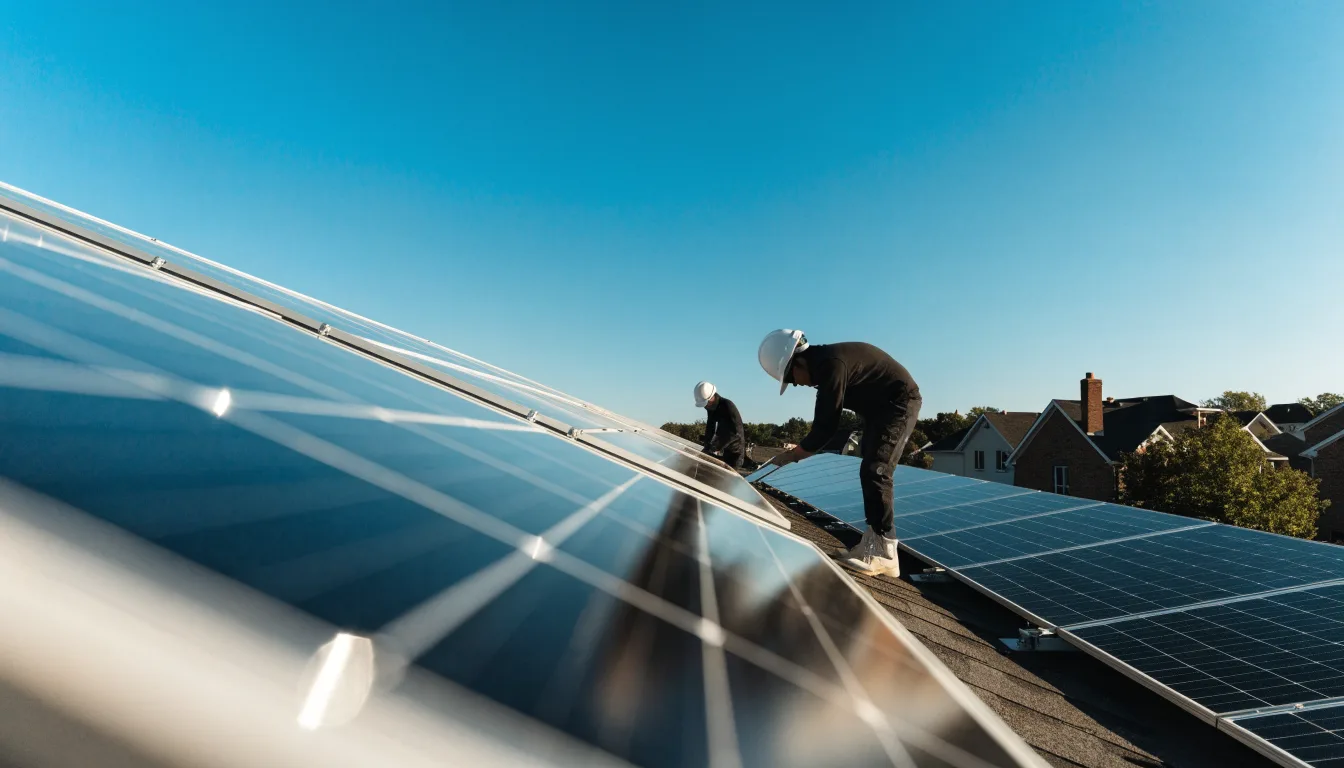
Solar panel installation is hands-on, outdoor work that pays a solid wage and does not require a four-year degree.
The U.S. Bureau of Labor Statistics has repeatedly listed solar PV installer among the fastest-growing occupations in the country.
That growth is driven by simple math: more homeowners, businesses, and utilities are adding solar every year, and every one of those systems needs skilled hands to install it.
Because the work is tied to physical rooftops and job sites, it cannot be outsourced overseas or fully automated.
Entry-level installers often start as helpers or apprentices, then move up to lead installer, crew foreman, or system designer as they gain experience.
For many people, it is one of the few well-paying careers you can enter within months rather than years.
Do You Need a License or Degree to Install Solar?
In most states you do not need a college degree to become a solar installer, which is a big reason the trade is so accessible.
What you often do need is training, on-the-job experience, and sometimes a state electrical or contractor credential depending on where you live and what part of the job you do.
Requirements vary widely by state, so the rules in California are not the same as those in Texas or Florida.
The honest picture is this: free online training gives you the knowledge foundation, but the actual license to pull permits and wire systems is regulated at the state level and usually involves a paid exam or a licensed contractor you work under.
Many installers begin by learning the fundamentals online, then join a solar company as an apprentice where they earn while completing the hands-on hours.
Think of free training as the door-opener that gets you conversation-ready and job-ready for that first entry-level role.
What Free Solar Installer Training Actually Covers
Good introductory solar courses walk you through how a photovoltaic system turns sunlight into usable electricity.
You will learn the main components: solar panels (modules), inverters, mounting racking, wiring, and the electrical panel connection.
Expect lessons on how to read a site, calculate roof orientation and tilt, and estimate how much energy a system can produce.
Courses also cover safety, which is critical since installers work at height and around live electrical current.
You will study the basics of electricity — voltage, current, series and parallel wiring — so the field work later makes sense.
Better courses also introduce system sizing, so you understand how a designer decides how many panels a home actually needs.
None of this replaces hands-on practice, but it gives you the vocabulary and concepts that let you show up to an apprenticeship already knowing the language.
Free Course vs. Paid Certificate: The Honest Difference
Here is where you need to read the fine print, because "free" can mean different things.
On many reputable learning platforms, the course content itself is genuinely free to study from start to finish.
What is often not free is a formal, printable certificate with the platform's seal, which you can usually choose to purchase if you want the document.
On Alison, for example, the courses are free to take, and you can access a free Learner Record that shows the modules you completed and your assessment scores.
If you want the official Alison certificate or diploma as a formal document, that is a paid add-on — but you are never forced to buy it to learn the material.
So the promise here is real: you can learn the skills at no cost. Just do not assume the free course automatically hands you an accredited industry credential.
For most people starting out, the knowledge and the free Learner Record are enough to reference on a resume and speak confidently in an interview.
How Real Solar Certification Works (NABCEP and State Rules)
If you want the credential that solar employers respect most, that is a separate step from any free online course.
In the U.S., the gold-standard industry certification is offered by NABCEP, the North American Board of Certified Energy Practitioners.
NABCEP certifications, such as the PV Installation Professional credential, require documented training hours, real installation experience, and passing a paid exam.
This is not something a free introductory course grants you, and any site claiming a free NABCEP certificate should be treated with caution.
The realistic path looks like this: start with free foundational training, get hired as an apprentice or helper, accumulate field hours, then pursue NABCEP or a state license once you qualify.
State electrical licensing is also separate and paid, handled by your state's licensing board rather than any course provider.
Knowing this upfront saves you from disappointment and helps you plan your career in the right order: free learning first, paid credentials once you are working and ready.
The Growing Path: Solar Battery and Storage Installer
One of the fastest-rising specialties in the solar world is battery storage, and it is worth understanding as an adjacent career path.
A solar battery, such as a Tesla Powerwall or similar home storage unit, stores the energy your panels produce so you can use it at night or during a power outage.
As more homeowners want backup power and energy independence, demand for installers who can wire and commission these battery systems is climbing quickly.
Storage work overlaps heavily with solar PV installation, but it adds skills around battery safety, energy management systems, and integrating storage with the electrical panel.
Because batteries involve larger amounts of stored energy, the safety and electrical knowledge bar is higher, which also means the pay ceiling tends to be higher.
Many installers now cross-train: they learn rooftop PV first, then add battery and storage certification to become more valuable to their employer.
Some manufacturers, including Tesla, run their own installer certification programs for their specific products, which crews often complete once they are hired.
If you are planning a solar career today, treating storage as a second skill to add — not an afterthought — is one of the smartest moves you can make.
Free foundational courses that cover both solar generation and battery storage give you a head start on this dual-skill path.
Skills That Make You Hireable Fast
Beyond the technical knowledge, solar employers value a handful of very practical traits.
Comfort working at height and outdoors in varying weather is essential, since most residential work happens on rooftops.
Basic tool familiarity, physical stamina, and attention to safety detail matter as much as knowing how an inverter works.
Reliability and showing up on time are, honestly, what separates workers who get promoted from those who do not.
A clean driving record helps too, because installers often travel to job sites in company vehicles.
If you can pair free online knowledge with even a little hands-on comfort using tools, you become a very attractive entry-level hire.
How to Access Free Solar Training Today
You do not need to wait, pay, or enroll in a semester-long program to get started.
Free online platforms let you begin studying solar fundamentals the same day, at your own pace, from any device.
Alison is one of the most widely used free learning platforms, offering courses on solar energy, photovoltaic systems, and renewable energy fundamentals at no cost to study.
You can work through the material on your schedule, take the built-in assessments, and keep a free Learner Record of what you completed.
If you later want a formal certificate document, that is an optional paid choice — but the learning itself does not cost anything.
Once you finish the fundamentals, use that knowledge to apply for apprentice or helper roles with local solar companies.
From there, you can stack on hands-on hours, add battery-storage skills, and eventually pursue paid credentials like NABCEP or a state license.
A Realistic Roadmap From Zero to Paid Installer
Here is a simple sequence that many successful installers have followed.
First, complete free online training so you understand how solar systems work and can speak the language.
Second, apply to solar companies for entry-level installer, helper, or apprentice positions, using your free Learner Record and enthusiasm to stand out.
Third, learn on the job, rack up real installation hours, and pay attention to the licensed electricians and lead installers around you.
Fourth, add a specialty such as battery storage to raise your value and open higher-paying work.
Fifth, once you meet the experience requirements, invest in a paid credential like NABCEP certification or a state license to unlock the top tier of jobs.
This path rewards patience and consistency far more than it rewards spending money upfront.
What Solar Installers Earn and How Pay Grows
Pay is one of the first questions people ask, and the honest answer is that it varies by region, experience, and specialty.
Entry-level helpers and apprentices start at a modest hourly wage, but that wage tends to rise quickly as you prove yourself on the job.
Lead installers, who run a crew and take responsibility for quality, earn noticeably more than first-year helpers.
Specialists who can design systems, handle electrical connections, or install battery storage command higher pay because those skills are harder to find.
Because solar is tied to construction and electrical trades, overtime and busy seasons can add to your earnings.
The pattern is clear: the more capable and certified you become, the more your income climbs — which is exactly why stacking skills over time pays off.
Where the Jobs Are: Residential, Commercial, and Utility Solar
Solar work happens across three broad segments, and understanding them helps you aim your career.
Residential solar involves installing panels on homes, and it is where many installers get their start.
Commercial solar covers larger rooftop and ground systems on businesses, warehouses, and public buildings, often with bigger crews.
Utility-scale solar means the massive solar farms that feed power to the grid, which involve different logistics and equipment.
Each segment offers different work environments, pay structures, and advancement paths, so it helps to try more than one.
Many installers move between segments over their careers, gaining a broad skill set that keeps them employable no matter where demand is strongest.
Tools and Gear You Will Use on the Job
Getting familiar with the tools of the trade helps you feel prepared before your first day.
Installers commonly use drills, wrenches, and specialized racking hardware to mount panels securely to a roof.
Safety gear is non-negotiable, including harnesses, hard hats, gloves, and proper footwear for working at height.
Electrical tools such as multimeters and wire strippers come into play when connecting the system.
Learning the names and purposes of this equipment during your free training means you will not feel lost when a crew leader hands you a tool.
Comfort with basic hand and power tools is one of the simplest ways to stand out as a promising new hire.
Common Mistakes to Avoid
The biggest mistake is paying a large sum to a program that promises guaranteed high-paying solar jobs — no course can guarantee employment.
Another is assuming a free course equals a recognized certification; free training builds knowledge, while recognized certification is a separate, usually paid step.
Some beginners skip the safety fundamentals in a rush to get to the interesting parts, which is dangerous in a trade that involves heights and electricity.
Others overlook battery storage entirely, missing one of the fastest-growing and best-paying corners of the industry.
Avoid these traps, follow the free-first roadmap, and you keep your money in your pocket while you build real skills.
Frequently Asked Questions
Is solar panel installer training really free?
Do I need a certificate to get a solar job?
How long does it take to learn solar installation?
What is the difference between solar and battery storage installation?
Is NABCEP certification free?
Start Learning Solar for Free Today
A clean-energy career is genuinely within reach, and it does not require a degree or a big upfront payment to begin.
Free online training gives you the knowledge foundation, and from there you can earn while you learn as an apprentice, then add storage skills and paid credentials over time.
The demand is real, the pay is solid, and the door is open — the only thing left is to take the first free step and start studying today.

